
AI Visibility is the discipline of ensuring a brand is not only indexed by AI systems but synthesized as a trusted authority within their answers. It combines AEO (Answer Engine Optimization), GEO (Generative Engine Optimization), and AIVO (Artificial Intelligence Visibility Optimization) to manage algorithmic trust, entity authority, and machine-readable brand signals.
Key Concepts:
- » AI Visibility
- » Answer Engine Optimization (AEO)
- » Generative Engine Optimization (GEO)
- » Artificial Intelligence Visibility Optimization (AIVO)
AI Visibility: The Revolution from Search Engines to Answer Engines
Being visible on the internet used to be simple.
Rank on the first page of Google.
Get the traffic.
Game over.
But today, we are in a much more dangerous era. Because people are no longer just “searching” the internet. They are asking their questions to Artificial Intelligence.
And if AI doesn’t include you in its answer…
you are considered non-existent in the digital world.
The 30-Year Evolution of Visibility: From Billboards to Algorithms
What is AI Visibility? To answer this, we must first start by asking, “What is visibility?”
Visibility is the state of a brand encountering its target audience not by chance, but through a strategic design. Over the last 30 years, this concept has evolved from physical billboards to digital indexes. In the Web 1.0 era, “just being there” was enough.
In the golden age of SEO, visibility turned into a war for the top spot in Google’s algorithmic labyrinths. Brands were trapped in keywords for years, optimizing content for crawlers rather than humans. However, today visibility has gone beyond driving traffic to a website and has become a matter of trust and reference.
We are currently at a major breaking point. In this new era where traditional search engines are being replaced by answer engines, visibility is no longer measured by click-through rates, but by the power of representation within the “mind” of AI.
As SEO gives way to GEO (Generative Engine Optimization) and AEO (Answer Engine Optimization), it is no longer enough for brands to just be indexed; they must be synthesized as an authority by LLM-based systems. Tomorrow’s visibility is not the art of existing in pixels on a screen, but in the DNA of the answers provided by AI.
What is AI Visibility?
AI Visibility refers to the process of a brand or an idea not just being scanned by AI systems, but being synthesized into the response as a trusted authority.
A major paradigm shift is taking place in digital marketing.
For the last 20 years, the KPI was the “click.” SEO, ads, content marketing… they all focused on increasing traffic.
But in the age of AI, the new KPI is synthesis.
Because the user often doesn’t click the link. They get the answer directly from AI. Therefore, the new visibility model is based on this question:
When a user asks a question, do you exist within that answer?
Today, AI visibility might seem like a new concept. But in reality, what is new is not visibility itself, but how it is measured.
Algorithms change. Platforms change. But the visibility problem remains constant. And that is exactly why we must ask:
Is algorithmic visibility really just a passing trend?
Why Algorithmic Visibility Will Never Die
In a rapidly changing digital ecosystem, the first question that comes to mind is: “How long will this strategy remain valid? In a world where everything becomes obsolete so fast, is AI Visibility worth the investment?”
Let’s be clear: The technical applications of AI Visibility today will surely change. But there is only one truth that will not change: The Problem.
What is that problem? Humans and companies must be visible within digital systems, always. This is the existential rule of the internet. Tools evolve, the problem remains:
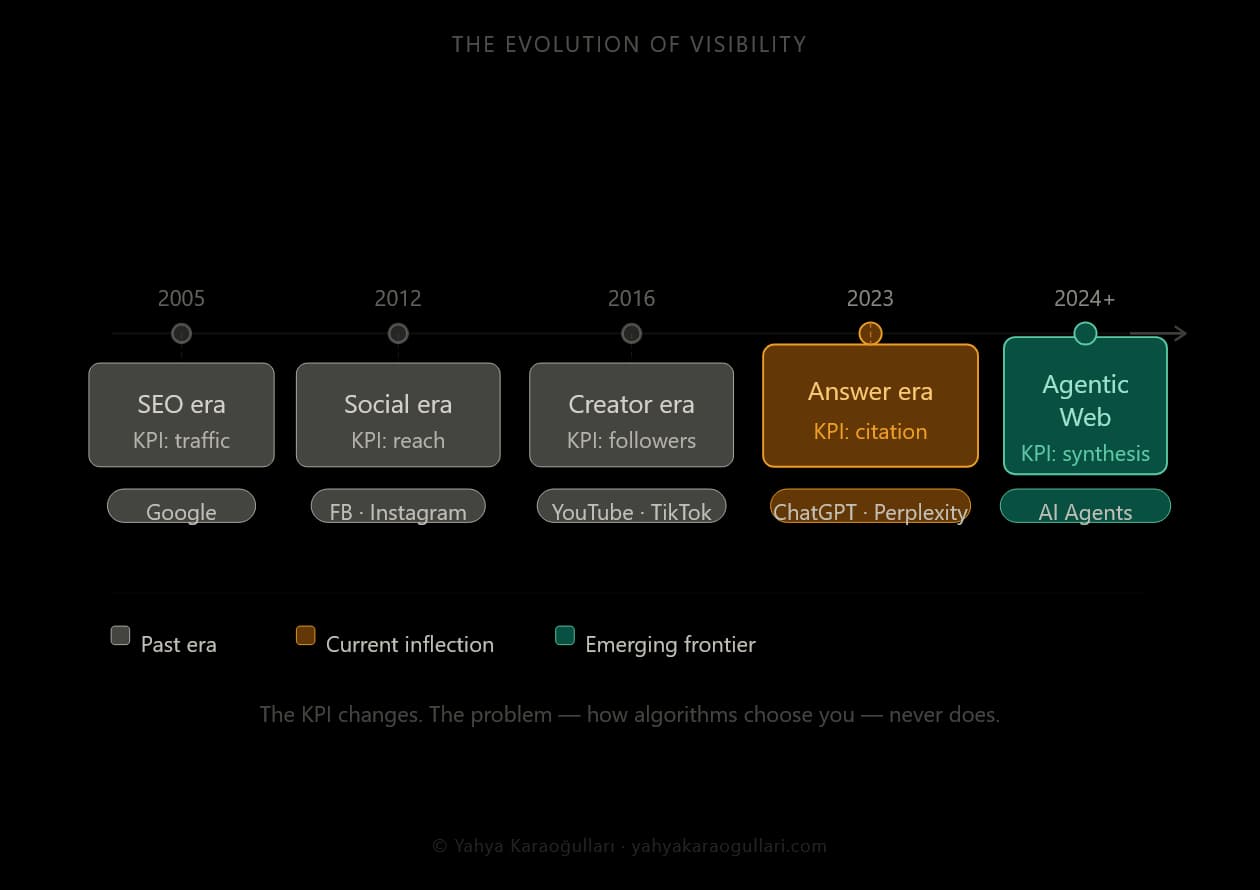
- 2005: Websites + Google SEO
- 2012: Social media algorithms
- 2016: Influencer and creator economy
- 2023: AI answer engines
- 2024+: Agentic Web (AI agents talking to each other)
The core question behind all these breakthroughs has never changed: “How do algorithms perceive me and include me in their recommendations?”
Yesterday it was called SEO, today it is AEO, GEO, or AIVO. Tomorrow, maybe something else. However, the set of rules for how machines perceive and choose brands is built on principles independent of technology:
- LLM Citation (The logic of attribution)
- Brand Authority (The power of the brand)
- Entity Trust (Trust in the digital entity)
- Content Footprint (The trace left by content)
Even if Google were to be replaced by another system today, these principles would not die. Because AI systems always need “trust signals” to process data.
So, does this investment have an expiration date?
No. Because as long as algorithms exist, the art of explaining yourself to them will continue to exist.
Constant Problem, Variable Tools
For instance, if the field of AI visibility were to die in 2 years, it would mean one of two things happened:
- AI has completely collapsed (which is a very, very low probability)
- AI visibility has become so critical that it has already become mainstream under another name.
So yes, this is the area to invest in.
This shift has happened throughout history. For example;
“Growth hacking” died, but growth didn’t.
“Inbound marketing” died, but content marketing grew.
Now “SEO” is dying, but the behavior of “searching” never dies.
Currently, the concept of AI visibility is very new; people don’t know it yet. Even experts are just beginning to recognize and talk about it. Agencies, old SEOs, growth hackers, AI consultants… But I have been talking about this, producing content, and developing frameworks since mid-2025. See my research paper:
From Search Visibility to AI Recommendation – A Conceptual Model of Interpretable Brand Identity for AI Systems
View Full-text on ResearchGate »
Also available on SSRN »
Essentially, based on Algorithmic Authority & AI Visibility, I have been working on algorithms, AI discovery, machine trust signals, and digital authority architecture since 2025.
The AI discovery layer is still in its early stages. Consequently, it is not yet taken seriously enough. But in a few years, everyone will be talking about it.
In short, even if SEO dies, search behavior does not.
The same applies to AI visibility.
The signal economy is immortal. Whether it’s the keyword-focused bots of 2025 or the reasoning-capable LLMs of 2026, all systems need a decision-making mechanism.
For a machine (AI today) to prefer one brand over another, it must collect “evidence.” When I talk about AI Visibility today, I am actually building this “digital evidence architecture.” Even if the technology changes, the principles of persuading machines (authority, trust, entity) do not change.
Managing Brand Authority in the Age of AI
90% of those experts, agencies, SEOs, and even AI consultants I just mentioned will either disappear or lose ground within a year or two. Because they think of AI as a “channel” (like Google). However, AI is not a channel; it is a new ‘ecosystem’.
That’s why I focus not on “how to be visible,” but on “why/how to be chosen by machines.” In other words, strategic entity positioning.
The Strategy of Tomorrow: AEO, GEO, and AIVO
What would we find if we did a bit of brainstorming and tried to predict what will happen in the coming days? Let’s take a look at how this SEO – AEO – GEO and AIVO trend might evolve in the short, medium, and long term.
First, let’s put an end to this confusion of terms and briefly define them.
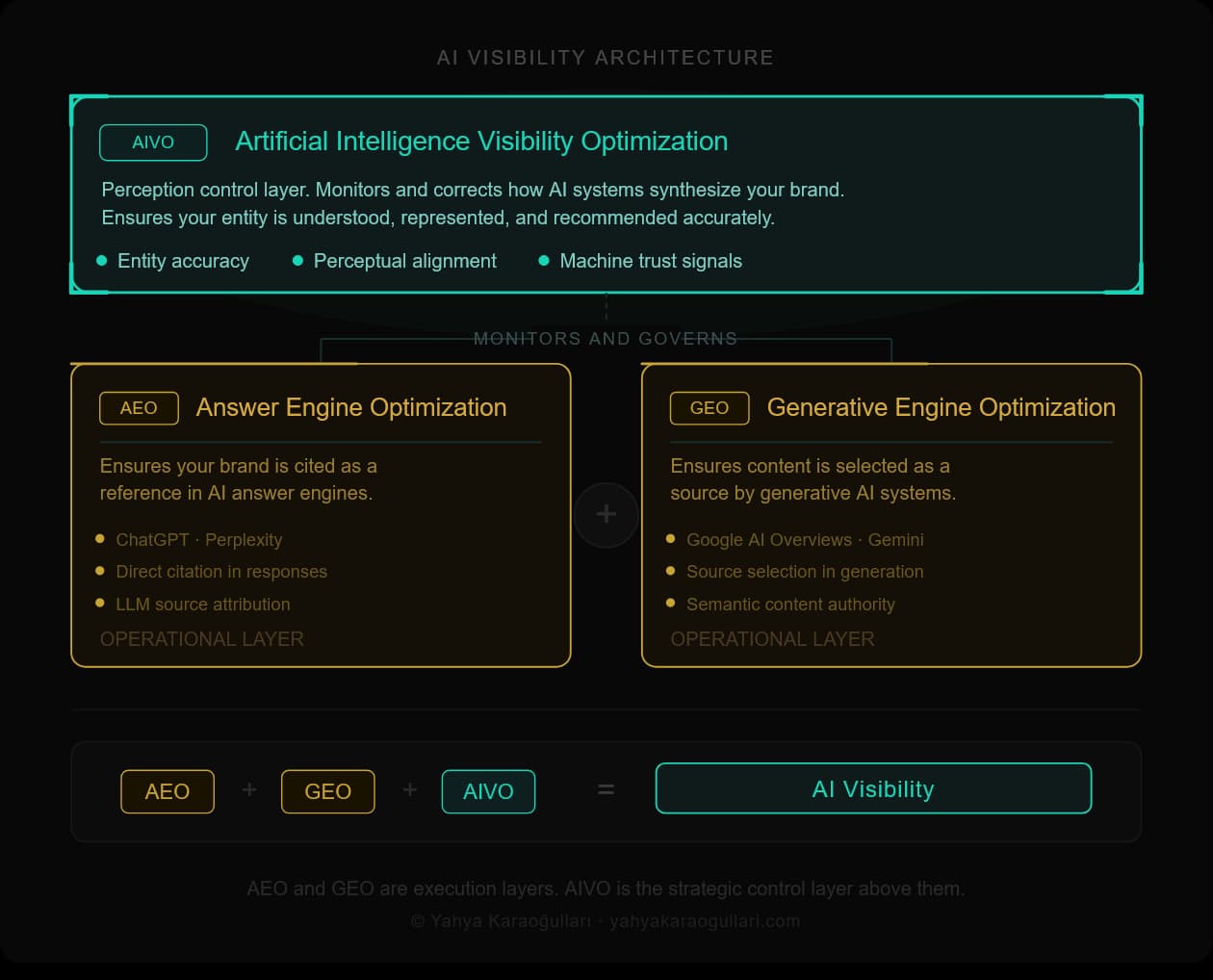
AEO (Answer Engine Optimization) is the optimization discipline that ensures a brand is cited as a reference in AI answer engines.
GEO (Generative Engine Optimization) is the optimization approach that ensures content is selected as a source by generative AI systems.
AIVO is the quality control layer of this system.
AIVO (Artificial Intelligence Visibility Optimization) is a quality control mechanism that monitors and corrects how AI perceives a brand.
In other words, AIVO asks:
Does AI understand my brand correctly?
How does it represent me while generating a response?
With which concepts does it associate me?
The most critical stage of the AI visibility strategy is managing the perceptual profile of the brand formed in AI systems.
Now let’s get to the trend…
I see the evolution of the trend as a three-stage breakthrough. The current AI visibility concept is just the beginning phase.
1. Short Term (0-12 Months): “Signal Bombardment” and the Validation War
This is the current stage. Companies are uncontrollably producing content to appear in AI answer engines.
The Breakthrough: AI companies (OpenAI, Perplexity, etc.) will push harder on Digital Fingerprinting and Verified Entity structures to prevent “hallucination” and “manipulation.”
The Result: Just producing content won’t be enough. The technical answer to the question “Did this brand really produce this content?” (strong signature instead of a weak signal) will be our main job.
2. Medium Term (1-3 Years): The “Personal AI Agents” Revolution
This is where the biggest paradigm shift happens. Today we look at “What does ChatGPT say?” Tomorrow there will be Personal Agents browsing the internet, shopping, and researching on your or my behalf.
The Breakthrough: Visibility will move from “being mentioned in a general answer” to “entering the radar of an individual’s private assistant.”
New Expertise: B2A (Business to Agent) Marketing. How will you convince a person’s assistant (AI Agent) that your brand is the “safest and most logical option”? This is a complete departure from classic SEO, directly meaning Data Trustworthiness and Decision Algorithm Manipulation (within ethical boundaries).
3. Long Term (3 Years+): “Invisible Visibility”
AI systems will no longer crawl the web to generate answers but will perfect their own closed-circuit Knowledge Graphs.
The Breakthrough: The act of “Search” will die, the “Result” will become standardized.
My Role: As a “Visibility Strategist,” I will have to make a brand a “Core Knowledge Block” of these closed-circuit systems. The brand will become an inseparable part of the AI’s “worldview.”
Strategic Prediction:
The trend will evolve from “Content Marketing” to “Data Architecture and Reputation Engineering.”
If you only say “let’s write articles so AI sees us” today, you will be left behind in 2 years.
I manage the logic of machines reading, trusting, and recommending data, and what I build in the background is actually Algorithmic Reputation Management.

Trust Signals and Entity Trust: How AI Chooses Your Brand
In a world where “Agents” (Personal AI Assistants) are the decision-makers, what would be the 3 most critical data signals required for a brand to prove it is the “best”? Let’s take a look.
I see this in three layers.
1. Verified Entity
The biggest problem for agents will be the question of who is real and who is not.
Because AI encounters these problems while crawling the internet:
- fake sites
- AI-generated content garbage
- manipulated reviews
- spam authority
Therefore, agents will ask: “Does this brand really exist?”
What are the signals for this:
- consistency of corporate identity
- entity graph connections
- official data sources
- media references
- connection with real people
Google has been doing this for years with the Knowledge Graph. But in the agent era, this will be much stricter. If a brand is not a verified digital entity, the agent will consider it risky.
That’s why the visibility game of the future will be Entity Architecture.
In other words, the brand should appear not as scattered content on the internet, but as a single defined entity.
2. Machine Trust Signals
Agents don’t want to take risks when making recommendations. Because a wrong recommendation kills user trust.
Therefore, agents calculate: “Will I be embarrassed if I recommend this brand?”
This is where these signals come into play:
- independent references
- authority connections
- expert content production
- academic / professional mentions
- cross-platform consistency
So it’s not just about content. It’s about algorithmic reputation.
All the traces a brand leaves on the internet come together to answer the question, “Is this brand a safe recommendation?” And agents will ignore risky brands.
3. Decision Efficiency
This is something very few people talk about. Agents don’t think like humans. They minimize decision costs. The easier it is to choose a brand, the more advantageous it is. For example, agents love this data:
- clear product definitions
- standardized data
- price transparency
- clear value proposition
- categorical positioning
In other words, a “decidable” brand. Because a complex brand means a low recommendation probability. Therefore, in the future, brands cannot rely solely on producing content. They will also have to produce machine-friendly data.
Summarizing These Three Signals in One Sentence
Winning brands in the agent world will be: Defined, Trusted, and Easy to decide upon.
Building Authority in the Age of AI
Now, let me tell you something very interesting. The real breakthrough might not even be the agent revolution. I think a much earlier breakthrough is coming. And if this happens, 95% of the people in the AI visibility field will be caught off guard.
Here is the breakthrough that no one expects but I predict: AIs might stop reading the web.
Instead, they might use:
- licensed data
- API data streams
- closed knowledge graphs
If this happens, classic content strategies will take a serious hit. This means a content → data transformation.
The migration of AI models from the chaotic structure of the web to closed-circuit and verified data pools is not a possibility; it is a process happening right now (like the Reddit-Google deal, or the licensing agreements news agencies are making with OpenAI).
If tomorrow AI systems start using only trusted data sources instead of crawling the web… What would be the most critical asset for a brand to enter that trusted data pool?
Digital Semantic Identity
A very critical question arises here: Does AI trust you when giving information about you to its user… or what others say about you?
This question leads us to the concept of Digital Semantic Identity. Because AI systems do not learn about a brand from a single source. They synthesize the brand from all references on the internet.
If AI systems stop crawling the web and start pulling data only from “safe havens,” what allows a brand to enter that haven is not its content, but its technical and semantic passport.
The 3 main components of this passport:
- Structured Entity Data: For AI models, being “readable” is not enough; being “processable” is necessary. All of the brand’s assets (products, founders, value proposition, achievements) must be defined with Schema.org or similar high-level ontologies, with such clarity that machines can make no reasoning errors. If data is “raw,” it stays outside. If data is “structured,” it is pulled into the pool.
- Relational Authority: In a closed-pool system, saying “I am good” has no effect. The AI assistant looks at this: “What links does this brand have with other authority blocks I already trust (academic databases, licensed media, official institutions)?” My job is to build the “Digital Reference Network” that will connect the brand to these trusted nodes. For example; while ChatGPT is making a claim about you, it looks not only at your website but also at the projection of that information in the ecosystem to verify the source of that information.
- Provenance & Attribution: For AI systems, the most valuable data is data with a clear source. Brands that can say “This data belongs 100% to this brand and has not been changed” using blockchain-based content verification or cryptographic signatures become VIP guests of the closed data pools.
Conclusion: AIVO (AI Visibility Optimization) is the New SEO
SEO taught us that those who are visible win. But in the age of AI, the new rule is different: Those who are synthesized win.
Because people no longer search for information. People want answers. And brands that are not included in that answer will remain only a footnote in the digital economy of the future.